OPEN SATURDAY!
Hip Pain or Back Pain? Relief Tips from a Clackamas Chiropractor
Did you know your back pain might actually be coming from your hips? Learn why drivers and accident victims suffer from hip tightness and how the Cobra pose can help.
2/24/20262 min read

Have you ever felt a sharp ache in your lower back that just won't go away, no matter how much you stretch your spine? Did you know that in many cases, the true culprit isn't your back at all—it’s your hips?
For my patients here in Clackamas, especially those spending long hours behind the wheel or recovering from a recent car accident, hip dysfunction is one of the most overlooked causes of chronic discomfort.
If You’ve Experienced This, You Aren’t Alone
When you sit for hours—whether you’re hauling freight or commuting through Portland traffic—your hip flexors (the muscles at the front of your leg) stay in a shortened, tight position. Over time, these muscles pull on your pelvis, tilting it forward. This creates a "tug-of-war" with your lower back, leading to that familiar, dull ache.
In a motor vehicle accident, the force of the impact often travels from the floorboard up through the leg into the hip socket. If the hip joint loses its normal range of motion, your lower back has to "overwork" to compensate.
The Simple Move: Why I Recommend the "Cobra"
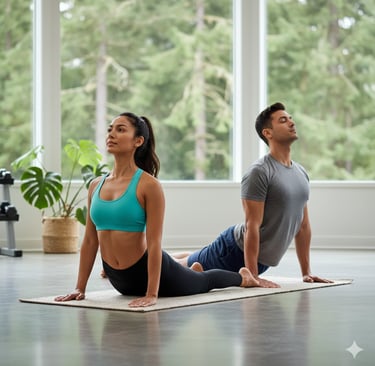
If you’re feeling that tightness, one of the most effective ways to reset the balance is a simple Cobra Pose (or McKenzie Lumbar Extension).
How to do it:
Lie flat on your stomach.
Place your hands under your shoulders.
Gently press your chest up while keeping your hips glued to the floor.
Breathe and feel the stretch through the front of your torso and hips.
This move helps reverse the "seated posture" and takes the pressure off the discs in your lower back. (I'll be posting an image of this above so you can check your form!)
The Professional Fix
Stretching at home is "the homework" (as I call it on my services page), but if the hip joint itself is restricted, you might need a manual adjustment to get things moving again. At JT Health Services, we look at the whole kinetic chain—from your feet to your neck—to make sure we aren't just treating the symptom, but the actual cause.